
Crown Molding and Baseboard Installation in Springfield and Fairfax, VA: A Homeowner's Complete Guide

Walk into any room in a Northern Virginia home that has professionally installed crown molding and you notice something immediately. The ceiling feels higher. The walls feel more intentional. The space reads as finished in a way that is hard to put into words but easy to see. Now walk into the same room without it and the junction between the wall and ceiling just ends, abruptly, with nothing to carry the eye from one surface to the other.

Crown molding is one of the oldest and most reliable tools in interior design for exactly this reason. It bridges the gap between wall and ceiling with a decorative profile that adds architectural depth, perceived height, and a sense of craftsmanship that bare drywall simply cannot replicate. When paired with properly scaled baseboards and matching door casings, it completes the interior trim system that separates a finished-looking home from one that feels like it still needs work.
At Vivanco's Trim, interior trim work is a core part of what we do throughout Springfield, Fairfax, Annandale, and surrounding Northern Virginia communities. This guide covers the types of crown molding, how to choose the right profile for your home, where it makes the biggest impact, and when to call a professional.
Key Takeaways
Crown molding bridges the wall-to-ceiling junction with a decorative profile that adds architectural depth and perceived height to any room.
Profile size should be proportional to ceiling height: narrower profiles for 8-foot ceilings, medium to wide profiles for 9-foot ceilings and above.
Wood and MDF are the two dominant materials for painted applications in Northern Virginia homes. Solid wood is preferred where staining is desired.
Baseboards should be proportional to crown molding and scaled to the room. Taller ceilings support taller baseboards.
Crown molding works best as part of a complete interior trim system that includes baseboards, door casings, and window surrounds.
Professional installation matters most at inside and outside corners, where mitering and coping skills directly determine the quality of the final result.
Table of Contents
What Crown Molding Does and Why Northern Virginia Homes Benefit From It
Crown Molding Profiles Explained
Choosing the Right Profile for Your Home Style
Crown Molding Materials Compared
Baseboards: The Foundation of the Interior Trim System
Where Crown Molding Makes the Biggest Impact
DIY vs. Professional Crown Molding Installation
Frequently Asked Questions
Schedule a Free Trim Consultation with Vivanco's Trim
What Crown Molding Does and Why Northern Virginia Homes Benefit From It
Crown molding is a finishing trim installed at the junction where the wall meets the ceiling. Its purpose is both decorative and compositional. Decoratively, it adds detail and architectural character to a plain room. Compositionally, it provides a visual frame that gives the room a sense of completeness and proportion.
Northern Virginia homes, particularly those built in Springfield, Fairfax, and Annandale between the 1960s and early 2000s, were constructed with a focus on practical floor plans and square footage rather than architectural detail. Many were delivered without crown molding entirely, or with minimal 2.5-inch stock that looks undersized against the rooms it was meant to finish. As homeowners invest in whole-home remodeling and interior updates, adding or upgrading crown molding is consistently one of the most impactful things a room can receive.
The effect is amplified when crown molding is part of a complete trim system. Crown at the ceiling, coordinated wainscoting or chair rail at mid-wall, and properly scaled baseboards at the floor create an interior that reads as thoughtfully designed from top to bottom. Each element reinforces the others.
Crown Molding Profiles Explained
Crown molding profiles fall into three main families. Understanding them helps homeowners make a choice that fits both the home's architecture and personal preference.
Profile Family | Key Characteristics | Best For |
Classical (Ogee, Dentil, Cyma) | Multi-curve S-shaped profiles, ornate detail, deep shadow lines | Colonial, Georgian, Federal, formal traditional homes |
Transitional (Cove, Simplified Ogee) | Single or gentle curves, moderate projection, clean finish | Transitional, craftsman, and contemporary colonial homes |
Contemporary (Stepped, Angular) | Flat stock layered for geometric shadow lines, minimal curves | Modern, minimalist, and mid-century interiors |
Ogee is the most widely used profile family in Northern Virginia residential work. As noted by This Old House, the ogee features an elongated S-curve combining concave and convex elements, which adds depth and formality while remaining versatile enough for most traditional home styles in Fairfax County.
Cove profiles use a single concave curve and produce a subtle, clean transition between wall and ceiling. They work particularly well in transitional interiors where the goal is to add finish without adding ornament.
Dentil molding uses a row of small rectangular blocks evenly spaced along a band. It is rarely used as a standalone crown profile in residential work, but it appears frequently as a component in built-up or layered crown assemblies on formal traditional staircases and dining rooms throughout Springfield and Fairfax.
Stepped/layered profiles combine multiple flat pieces of trim to create a wide, multi-dimensional crown with geometric shadow lines. These are the right choice for contemporary and transitional interiors where clean angles matter more than curves.
Choosing the Right Profile for Your Home Style
Matching crown molding to the home's existing architecture is the most important decision in the selection process. A profile that is out of scale or out of character with the rest of the interior draws attention to itself rather than completing the room.
Colonial and Traditional Homes are the most common home styles throughout Springfield, Fairfax, and Annandale. They pair naturally with ogee profiles, dentil details, or classic multi-curve designs that complement rather than compete with the door and window casings in the room. Colonial crown molding draws from Roman and Georgian architectural traditions and is characterized by restrained elegance and clean symmetry.
Craftsman and Bungalow Homes call for restraint. Craftsman trim philosophy emphasizes simplicity and honest construction over ornamentation. Simple flat or step profiles, wide baseboards, and square-edge casings are the right choices here. Overly ornate crown in a craftsman interior disrupts the design language the architecture is built around.
Transitional Homes have the most flexibility. A simplified ogee or cove profile applied consistently across all rooms and in proportion to the ceiling height works in almost any transitional interior. This is the profile family that bridges traditional and contemporary most naturally, which explains its growing popularity in Northern Virginia remodels as homeowners update older homes toward a cleaner aesthetic.
Ceiling height drives size selection. A general rule used by professional trim carpenters in the area: rooms with 8-foot ceilings should use crown molding no wider than 3.5 inches in face width. Rooms with 9-foot ceilings can support 4 to 5.5 inches. Rooms with 10-foot or higher ceilings can carry 5.5 inches and above, including built-up assemblies. Crown that is too wide for the ceiling height feels heavy and compresses the room rather than lifting it.
Crown Molding Materials Compared
Material | Appearance | Best Application | Virginia Climate Notes |
Solid Wood | Warm grain, accepts stain or paint | Stained applications, premium painted rooms | Expands and contracts seasonally; needs acclimation |
MDF | Smooth, paintable surface | Painted applications throughout the home | Stable dimensionally; avoid in wet areas |
Moisture-Resistant MDF | Same as MDF | Bathrooms, laundry rooms | More dimensionally stable in humidity |
Polyurethane/PVC | Lightweight, seamless | Basements, bathrooms, high-humidity spaces | Fully moisture-resistant; does not accept stain |
For the vast majority of crown molding work in Northern Virginia homes, MDF is the material of choice for painted applications. It produces a glass-smooth painted surface, holds a crisp profile edge, and does not expand or contract with seasonal humidity changes the way solid wood does. Virginia's humid summers and cold dry winters create enough movement in solid wood trim to open joints over time if the material is not properly acclimated and the installation does not account for movement.
Solid wood remains the right choice when staining is the goal. Oak, poplar, and maple are common species for stained crown applications. The wood grain that makes stained trim look rich is the same characteristic that requires more careful installation and more attention to seasonal acclimation.
Polyurethane and PVC profiles are the practical choice for bathrooms, laundry rooms, and basement spaces where moisture resistance matters more than the ability to stain.
Baseboards: The Foundation of the Interior Trim System
Baseboards complete the bottom of the wall the same way crown molding completes the top. They protect the wall from scuffs, furniture contact, and vacuum damage while providing a visual base that grounds the room and frames the floor surface.
The relationship between baseboard height and crown molding width matters for the room to feel proportionally balanced. A general guideline professional trim carpenters follow: baseboard height should be roughly two-thirds to three-quarters the face width of the crown molding installed in the same room. A room with 4.5-inch crown works best with a 3 to 3.5-inch baseboard. A room with 6-inch built-up crown supports a 4 to 5-inch baseboard.
Common baseboard profiles for Northern Virginia homes:
Colonial base features a flat central body with a rounded top edge and a small step at the bottom. It is the most common profile installed in Fairfax County homes built in the 1980s and 1990s and pairs cleanly with most traditional and transitional interior styles.
Craftsman base uses a taller flat body with a square top edge and minimal profiling. It reads as modern and clean while still providing the visual weight a well-finished room needs at the floor line.
Built-up base combines a flat base board with a separate base cap molding at the top and a base shoe at the floor. The result is a taller, more dimensional baseboard that adds significant architectural presence, particularly in rooms with higher ceilings or more formal design intent.
Baseboard installation also plays a practical role at the floor transition. A properly fitted base shoe molding at the bottom of the baseboard accommodates minor gaps between the baseboard and finished floor, which is especially important after new flooring installation where the floor surface has changed height from the original.
Ready to upgrade the trim in your Springfield or Fairfax home? Call Vivanco's Trim at (703) 499-2045 or request your free estimate online.
Where Crown Molding Makes the Biggest Impact
Not every room needs crown molding and not every room needs the same crown molding. Priority rooms for trim upgrades in Northern Virginia homes, based on visual impact and return on investment:
Foyer and entryway is the first space visitors see and the space that sets the tone for the rest of the home. Crown molding in the entry, paired with consistent baseboards and casing around the front door, delivers an immediate impression of architectural quality.
Living room and dining room are the formal gathering spaces that benefit most from the perceived ceiling height and detail that crown molding provides. These are the rooms where built-up profiles and wider crown widths make the strongest design statement.
Primary bedroom is a space where the investment in detail is consistently noticed by homeowners planning a home sale. Crown molding in the primary bedroom adds a level of finish that is associated with premium construction.
Hallways are often overlooked but are among the most visually efficient spaces to trim. Because the wall surface-to-linear-foot ratio is high, crown molding in a hallway runs a relatively short length while covering the full visual field of anyone walking through.
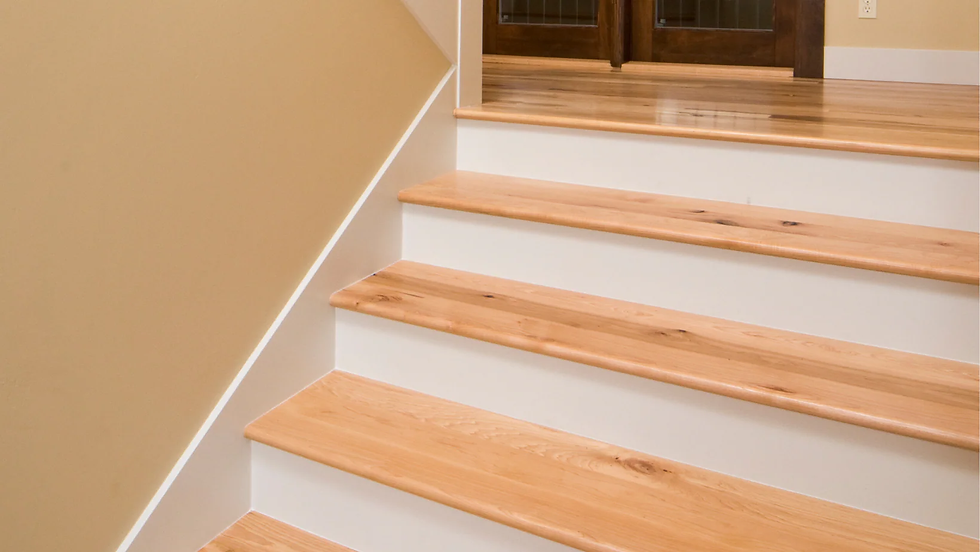
Stairwell and landing is where crown molding installation becomes technically demanding due to the raked ceiling angles on the stair wall. This is also where the visual payoff is significant, because the staircase is a focal point of the home's interior. Pairing crown at the stair landing with a stair remodeling project is a natural and efficient combination.
DIY vs. Professional Crown Molding Installation
Crown molding is one of the most commonly attempted DIY interior projects and one of the most commonly redone by professionals. The challenge is not the concept. It is the execution at the corners.
Inside corners require either a precise compound miter cut or a coped joint where one piece is cut to fit the profile of the other. Coped joints are the professional standard because they accommodate the fact that walls in most Northern Virginia homes are not perfectly square. A coped joint closes cleanly even when the corner is 89 or 91 degrees. A miter joint in an out-of-square corner opens a visible gap that no amount of caulk fully resolves.
Outside corners require compound miter cuts that account for both the spring angle of the crown and the wall angle simultaneously. In a room with standard 90-degree outside corners, this is manageable with the right setup. In a room with bay windows, angled walls, or cathedral ceilings, compound miter work requires significant skill and experience to achieve clean results.
The finish work after installation is where quality most clearly separates professional from DIY. Gaps at corners, transitions, and joints must be filled precisely. Nail holes must be set and puttied. Caulk lines must be fine and consistent. The paint must be applied in a way that reveals rather than obscures the profile of the molding. Each of these steps requires patience and skill that comes from repetition.
Professional installation ensures your trim investment delivers the clean, intentional result it should.
Frequently Asked Questions
What size crown molding is right for an 8-foot ceiling?
For 8-foot ceilings, crown molding with a face width of 2.5 to 3.5 inches is most proportional. Wider profiles on low ceilings compress the visual space and draw the ceiling down rather than lifting it. A simple cove or small ogee profile in this size range reads as intentional and appropriate.
Is MDF or wood better for crown molding in Virginia?
MDF is better for painted crown molding applications in most Virginia homes. It produces a smoother painted surface, holds profile edges crisply, and is more dimensionally stable through Virginia's seasonal humidity swings. Solid wood is the right choice only when staining is the goal.
Can crown molding be added to just one room?
Yes. Crown molding can be installed in one room at a time. However, for a consistent interior design result, the same profile should be used throughout connected rooms on the same floor. Mixing profiles in adjacent rooms creates a visual inconsistency that is noticeable from transitional spaces like hallways.
Does crown molding increase home value in Virginia?
Crown molding adds perceived value and contributes to a home feeling more finished and premium, which supports faster sales and stronger buyer interest. It is not a line item in a formal appraisal but consistently influences how buyers experience and value a home during showing.
How long does crown molding installation take?
A single room with standard 90-degree corners typically takes a professional installer two to four hours. Larger rooms, rooms with outside corners or angled walls, and full-home trim packages take longer and are scheduled over multiple days. Your installer can give a precise timeline after measuring the scope.
Schedule a Free Trim Consultation with Vivanco's Trim
Whether you are adding crown molding to a single room, upgrading baseboards and door casings throughout the home, or planning a complete interior trim package, Vivanco's Trim is ready to help. We serve homeowners throughout Fairfax County and a 15 to 20-mile radius of Woodbridge, Virginia, with expert interior trim installation that reflects the home's architecture and the homeowner's vision.
We start every project with a free in-home consultation, walk through profile and material options, and provide a clear estimate before any work begins. Our craftsmen take corner work and finish quality seriously on every installation because that is where the investment either pays off or falls short.
Call (703) 499-2045 or (571) 567-4424 7646 Fullerton Rd Suite A, Springfield, VA 22153 Monday – Friday: 7:00 AM – 7:00 PM | Weekends: By Appointment
References:
This Old House. (2025). What to Know About Crown Molding Forms.
Mouldings One. (2026). Crown Molding Styles: How Pros Choose Profiles That Match Trim Packages.
Engineer Fix. (2025). Types of Crown Molding: Materials, Profiles, and Sizes.


Comments