
Open Riser vs. Closed Riser Stairs in Northern Virginia: Which Is Right for Your Home?

When homeowners in Springfield and Fairfax start planning a stair renovation, the first question is usually about looks. But after that conversation about style and finish, a more practical question comes up: should the risers be open or closed? It sounds like a minor detail. In reality, it shapes how your staircase is built, how it functions every day, and whether it works for your specific household.
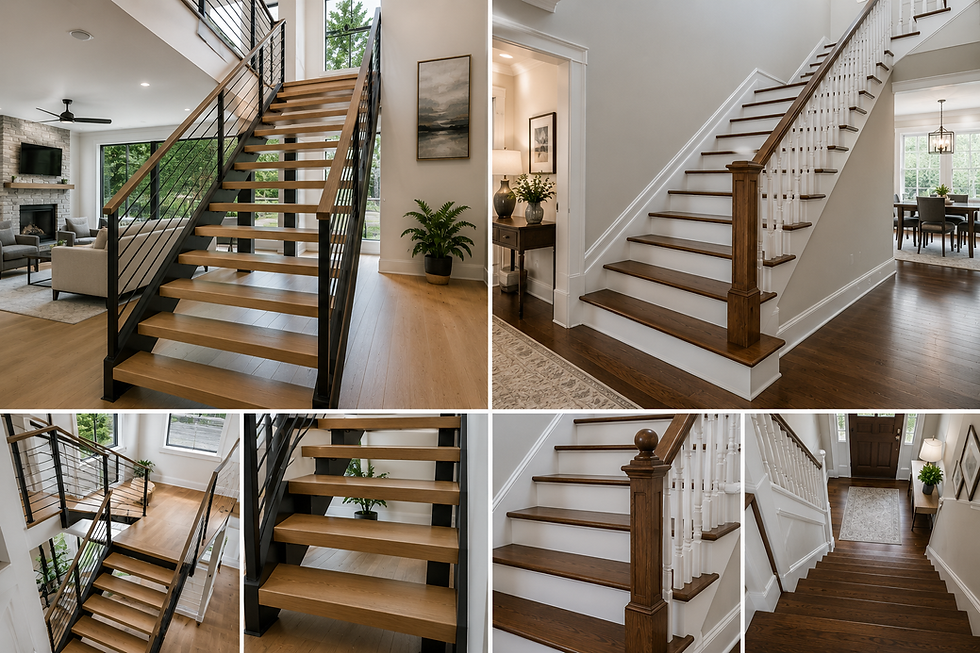
This guide breaks down the real differences between open riser and closed riser staircases, including Virginia building code requirements, cost differences, safety considerations, and which option makes the most sense depending on your home, your lifestyle, and who lives with you.
Key Takeaways
Open riser stairs leave the vertical gap between treads uncovered, creating a modern, airy look. Closed riser stairs use a solid vertical board between each tread for a traditional, enclosed appearance.
Both styles are code-compliant in Virginia when properly constructed, but open risers must meet specific gap and guardrail requirements.
Open risers require stronger structural framing because the riser board normally provides backing support for the tread.
Homes with young children, toddlers, or small pets should weigh the gap requirements of open risers carefully.
Closed risers typically cost less to build and are more forgiving to install because the solid structure hides imperfections.
The right choice depends on your home's architecture, your household, and your long-term renovation goals.
Table of Contents
Understanding the Difference: Open Riser vs. Closed Riser
An open riser staircase removes the vertical board between each tread, leaving a visible gap through which you can see the space below. A closed riser staircase uses a solid vertical board under every tread, completely enclosing the space between steps.
The riser board is the vertical face of each step. In a closed riser design, it connects the front of one tread to the back of the one below it. Remove it, and you have an open riser. That single difference changes the structure, the appearance, and the behavior of the staircase in ways that go well beyond aesthetics.
Open risers became popular through mid-century modern architecture and have surged again in Northern Virginia homes as homeowners move toward cleaner, more minimalist interiors. Closed risers have been the residential standard for decades and remain the dominant choice for traditional and transitional homes throughout Fairfax County and Springfield.
[IMAGE: Side-by-side comparison of open riser floating staircase and closed riser traditional staircase in Northern Virginia home interior] Alt text: "Open riser vs closed riser staircase comparison for Northern Virginia homes showing structural and visual differences"
Virginia Building Code Requirements for Each Style
Both open and closed riser staircases are permitted under Virginia's residential building code, but open risers carry specific requirements that must be met for the design to be code-compliant.
Virginia follows the International Residential Code with state amendments. Under those rules, open riser construction on stairs more than 30 inches above grade is only permitted when the openings between treads do not allow a 4-inch diameter sphere to pass through. This is the same 4-inch sphere rule that governs baluster spacing, and it is a hard safety requirement, not a suggestion.
The Virginia IRC amendments also specify that the maximum riser height is 8-1/4 inches and the minimum tread depth is 9 inches, which differs slightly from the base IRC standard. For open riser stairs, meeting the sphere rule while staying within tread depth requirements often requires careful engineering.
If you are dealing with stairs above 30 inches that you want to open up, horizontal rails, cable panels, glass panels, or partial risers are common solutions that keep the open aesthetic while satisfying the code gap requirement. A knowledgeable stair contractor will plan these details before the first board is cut.
Code Requirement | Open Riser | Closed Riser |
4-inch sphere rule (gaps) | Must comply when above 30 inches | N/A, no gaps present |
Max riser height (VA) | 8-1/4 inches | 8-1/4 inches |
Min tread depth (VA) | 9 inches | 9 inches |
Riser height consistency | Max 3/8-inch variation in flight | Max 3/8-inch variation in flight |
Tread nosing | Required if tread depth is under 11 inches | Required if tread depth is under 11 inches |
Structural Differences and Why They Matter
The riser board in a closed staircase does more than close off the visual gap. It provides structural backing that helps support the tread from below and distributes load across the full step surface. When you remove that board, the tread must carry its load independently, which typically means using thicker or engineered tread materials and heavier structural framing.
Open riser staircases often use steel stringers, floating tread mounts, or heavier solid wood treads to compensate for the missing structural support. This is one of the reasons why open riser installations can cost more and take longer to build correctly. The framing must be precise because there is nothing to hide misalignment. Every component is visible from below and from the side.
Closed riser stairs are more forgiving structurally. The riser boards help lock the system together, the underside is typically enclosed with drywall or wood paneling, and traditional stringer-and-riser construction is well understood by most finish carpenters. For most replacement or renovation projects in Springfield and Fairfax, closed riser work is faster to execute and more predictable in the finished result.
Safety Considerations for Northern Virginia Households
Safety is the most important practical factor when choosing between open and closed risers, and it depends heavily on who lives in your home.
Homes with young children or toddlers. The 4-inch sphere rule exists specifically to prevent small children from slipping through or getting a limb caught in open riser gaps. While a properly code-compliant open riser installation reduces this risk, many parents choose closed risers to eliminate it entirely.
Homes with small dogs or cats. Smaller pets can slip through or fall through open riser gaps, particularly on steeper staircase runs. This is a genuine concern that many homeowners overlook until after installation.
Older adults or anyone with balance concerns. Open riser stairs can create a visual depth perception challenge for older adults. The visual cue of looking through the treads while ascending can increase anxiety and disorientation. Closed risers provide a solid visual reference for each step.
Households without these concerns. For households without young children, small pets, or balance concerns, a properly built and code-compliant open riser staircase is as safe as any closed riser design. The framing and tread anchoring must be solid, and handrail grip must be secure.
Not sure which stair style is right for your home? Vivanco's Trim offers free in-home consultations throughout Springfield, Fairfax, Annandale, and Northern Virginia. We walk you through both options with samples in your actual space. Call (703) 499-2045 or schedule your free estimate online.
Cost Comparison: Open Riser vs. Closed Riser in Fairfax and Springfield
Open riser staircases generally cost more to build than closed riser designs. The additional cost comes from three main sources: heavier tread materials required for cantilevered or floating installation, more precise structural framing, and the visible finishes required on every surface since nothing is hidden by a closed underside.
Closed riser installations use standard stringer-and-riser construction that is well understood and efficient to execute. The riser boards are less expensive than the engineered steel supports or thick hardwood slabs common in open riser builds, and the enclosed underside means subfloor imperfections do not need to be perfect.
Here is a general cost comparison for a standard residential staircase run in the Northern Virginia market:
Configuration | Typical Range per Stair Run (13-14 steps) |
Closed riser, standard hardwood treads | $3,500–$7,000 |
Closed riser, premium species or custom finish | $6,000–$10,000 |
Open riser, solid hardwood floating treads | $7,000–$14,000 |
Open riser, steel stringer with hardwood treads | $12,000–$20,000+ |
These are planning ranges for full stair builds or major renovations. Partial replacements, riser-only conversions, or projects that keep existing structural elements will differ. See our stair repair and renovation services page for a better sense of what different project types involve.
Which Style Fits Your Northern Virginia Home?
The right choice between open and closed risers is not one-size-fits-all. It depends on your home's architecture, your household needs, your budget, and the overall direction of your interior renovation.
Choose open risers if your home has a modern, contemporary, or minimalist interior, you want to maximize light flow between floors, your household does not include young children or small pets, and you have the budget for heavier structural materials and precise installation.
Choose closed risers if your home is traditional, transitional, or colonial in style, which is true of a large portion of homes in Fairfax County and Springfield. They are also the right call when you want a faster and less expensive renovation, you have children or pets, or you want the option to store items under the stairs in an enclosed space.
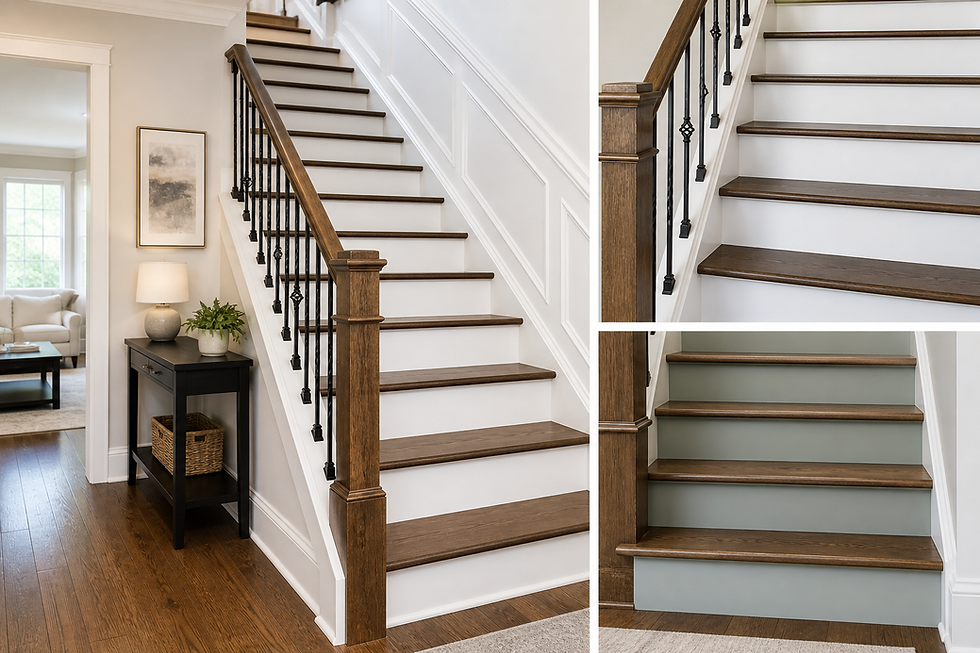
Consider a hybrid approach. Some homeowners in Northern Virginia are choosing a combination: closed riser construction with open-style balusters, glass railing panels, or cable systems that create the open, airy feeling without the structural and safety tradeoffs of true open risers. This approach is growing in popularity for transitional homes and is something Vivanco's Trim can design and build.
You can see examples of both styles in our project gallery to compare finished results before making a decision.
Open Riser vs. Closed Riser Stairs FAQs
What is the difference between open riser and closed riser stairs?
Open riser stairs have no vertical board between treads, leaving a visible gap. Closed riser stairs use a solid vertical board between each step, fully enclosing the staircase. Both are code-compliant in Virginia when properly built.
Are open riser stairs safe in homes with children?
Open riser stairs can be built to Virginia code, which requires gaps to prevent a 4-inch sphere from passing through. However, many parents choose closed risers to fully eliminate gap-related safety concerns for young children and toddlers.
Are open riser stairs allowed by Virginia building code?
Yes. Virginia building code permits open riser stairs when openings do not allow a 4-inch sphere to pass through for stairs more than 30 inches above grade. Both styles must also meet tread depth and riser height requirements.
Do open riser stairs cost more than closed riser stairs in Northern Virginia?
Generally yes. Open riser designs require thicker tread materials, heavier structural framing, and more precise visible finishes. Expect a 30 to 60 percent premium over a comparable closed riser build in the Northern Virginia market.
Can I convert closed riser stairs to open riser stairs?
Conversion is possible but involves structural changes to the stringer system and often requires new tread materials. A professional stair contractor should evaluate your existing staircase before attempting a conversion.
Do open riser stairs require more maintenance?
Open riser stairs accumulate dust on the tread undersides and within the gaps more visibly than closed riser designs. The open surfaces also require finishing on more faces of the tread material. Maintenance is manageable but more thorough.
Which style adds more home value in Fairfax County?
Both styles can add value when well executed. In Fairfax County's traditional and transitional housing market, a high-quality closed riser renovation with modern railing typically has broad resale appeal. Open risers appeal strongly to buyers seeking modern design but may narrow your buyer pool.
What staircase style is most popular in Springfield, VA?
Closed riser staircases remain the dominant style in Springfield due to the prevalence of traditional and colonial home styles in the area. Open risers and hybrid designs are growing in newer builds and extensively renovated homes.
Can I have a modern look with closed risers?
Yes. Closed risers pair very well with modern flat handrail profiles, metal balusters, painted white risers against stained wood treads, and cable or glass railing panels. The riser style does not limit the modernity of the overall design.
Does Vivanco's Trim build both open and closed riser staircases?
Yes. Vivanco's Trim designs and installs both open and closed riser staircases throughout Northern Virginia, including hybrid designs that combine the structural advantages of closed risers with the open aesthetic of modern railing systems.
Talk to Vivanco's Trim Before You Decide
Choosing between open and closed risers is a decision that affects the structure, safety, budget, and look of your staircase for decades. It deserves more than a quick Google answer.
At Vivanco's Trim, we have built and renovated staircases throughout Springfield, Fairfax, and Northern Virginia using both approaches, and we have seen firsthand which choices hold up best in different homes and households. A free in-home consultation costs you nothing and gives you the information you need to make the right call.
Call (703) 499-2045 or contact us online to schedule your free estimate. We serve a 15 to 20-mile radius of Woodbridge, VA including Springfield, Fairfax, Annandale, Dumfries, and surrounding Northern Virginia communities.
About the Author
Jose Vivanco is the owner and lead craftsman at Vivanco's Trim, a Northern Virginia stair design and home renovation company serving Springfield, Fairfax, and surrounding communities. With years of hands-on experience in stair construction, railing installation, and fine interior detailing, Jose brings both technical precision and an eye for design to every project.
References
Proline Flooring LLC: Open Riser vs Closed Riser Stairs Pros and Cons — Source for structural differences and IRC gap requirements
Senmit: Open Riser vs Closed Riser Staircase Comparison Guide — Source for safety, design, and household suitability guidance
Quora Discussion: IRC and Virginia Stair Code Amendments — Source for Virginia-specific IRC amendment specifications on riser height and tread depth


Comments