
Stair Riser Replacement and Painted Risers in Fairfax and Springfield, VA: What Homeowners Need to Know

Most homeowners think about stair treads when a staircase starts looking worn. The tread is where your foot lands, after all, and wear on the walking surface is easy to see. But the riser, the vertical board that closes the space between each step, plays an equally important role in how a staircase looks and how structurally sound it feels underfoot.
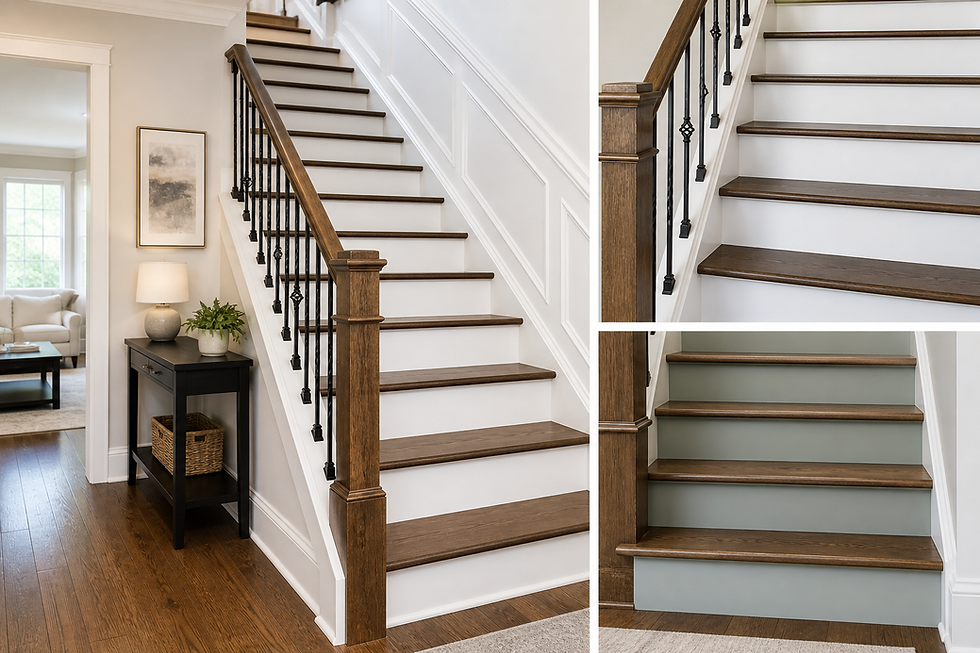
When risers are cracked, warped, squeaky, or painted in a color that no longer matches the interior, the entire staircase reads as unfinished regardless of how well the treads are holding up. And in many Northern Virginia homes where carpet was removed to reveal builder-grade pine risers underneath, the contrast between new hardwood treads and beat-up risers is immediately obvious.
The good news is that riser replacement is one of the cleanest and most efficient staircase upgrades available. New risers, whether finished in natural wood to match the treads or painted white in the most popular combination seen throughout Fairfax County and Springfield today, transform the look of a staircase without touching the structural elements beneath.
At Vivanco's Trim, riser replacement and finishing is part of the staircase work we do throughout Springfield, Fairfax, Annandale, and the surrounding Northern Virginia area. This guide covers what risers do, when they need replacing, material options, and why the white riser and hardwood tread combination has become the standard in area remodels.
Key Takeaways
Stair risers are the vertical boards between each tread that close the space between steps and contribute to the staircase's structural rigidity.
Cracked, warped, squeaky, or visually inconsistent risers are valid reasons for replacement even when treads are in good condition.
White painted risers paired with stained hardwood treads is the most requested staircase finish combination in Fairfax County and Springfield renovations.
Poplar is the preferred species for paint-grade risers because of its smooth grain and excellent paint adhesion.
Riser replacement can be done independently of tread replacement in most cases, but addressing both at the same time is the most efficient approach.
Professional installation ensures tight joints at the tread-riser intersection, which eliminates the squeaking that loose or poorly fitted risers cause.
Table of Contents
Replacing Risers Without Replacing Treads
What Stair Risers Do and Why They Matter
A stair riser is the vertical board that fills the space between the back of one tread and the front edge of the tread below it. In a closed riser staircase, every step is enclosed on its vertical face. The riser connects to the tread above and below it and contributes to the overall rigidity of the stair assembly.
Risers do more than close a visual gap. They support the nose of the tread above, distribute load across the stringer beneath, and prevent lateral movement that would cause the staircase to flex and creak under foot traffic. A riser that is cracked, loose, or poorly fitted transfers those structural failures directly into the sound and feel of every step.
Visually, the riser is the most prominent vertical surface on a staircase when viewed from the bottom of the flight looking up. Because risers repeat consistently from bottom to top, any damage, inconsistency in color, or poor finish quality is visible across the full height of the staircase at once. This is why a fresh set of risers, properly painted or finished, has such an immediate impact on how the staircase looks as a whole.
For a broader overview of how risers relate to the rest of the stair system, see our guide to open riser vs. closed riser stairs.
Signs Your Stair Risers Need to Be Replaced
Visible cracks or splits running through the face or thickness of the riser board. Surface cracks that are purely cosmetic can sometimes be filled, but cracks that extend through the board's thickness compromise the riser's structural contribution and require full replacement.
Warping or bowing away from the tread or stringer. A riser that has pulled away from its contact points is no longer contributing to staircase rigidity and will cause the step above it to flex and eventually squeak.
Persistent squeaking that is not resolved by surface repairs. Squeaking at the riser-to-tread joint is one of the most common stair complaints in Northern Virginia homes and is caused by the riser moving against the tread as weight is applied. Tightening fasteners from below resolves it in some cases, but a riser that has warped or dried out beyond its original profile needs replacement to stop the noise reliably. Our squeaky stair repair guide covers how to diagnose the source before deciding on the repair approach.
Finish that cannot be brought back. Builder-grade pine risers installed under carpet in many 1980s and 1990s Fairfax County homes are not finish-grade material. When carpet is removed, these risers are often rough, stained, and poorly surfaced. Painting over them without proper preparation produces a finish that peels and looks uneven. In these cases, replacement with a proper paint-grade riser board produces a dramatically better result than trying to refinish the original.
Color or style that no longer matches the interior. A set of dark-stained risers that made sense in a previous decade can look dated next to updated floors, trim, and wall colors. Replacing them with painted white risers is the most common solution in area remodels.
The White Riser and Hardwood Tread Combination Explained
White painted risers with stained hardwood treads have become the dominant staircase finish choice in Northern Virginia remodels over the past decade, and for good reason. The combination works because it does three things simultaneously.
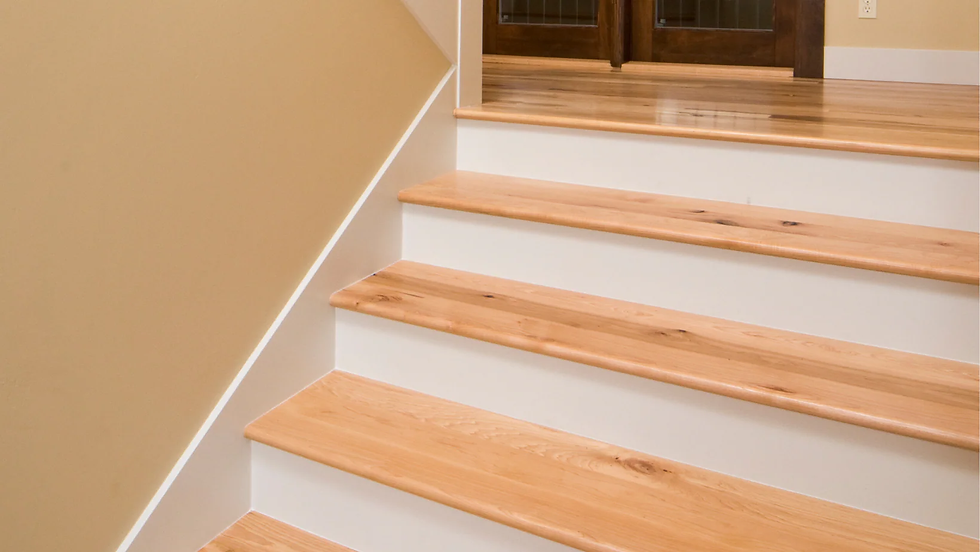
First, it creates visual contrast. The white vertical surfaces make the horizontal tread surfaces stand out more clearly, which improves depth perception on the staircase and makes each step easier to read from above. This is genuinely useful for safety, particularly in lower-light conditions.
Second, it ties the staircase to the interior color palette. White trim, white doors, and white risers create a cohesive relationship between the staircase and the surrounding interior that a fully stained staircase does not. In a home with white baseboards, white door casings, and neutral or painted walls, white risers make the staircase feel like part of the interior design rather than a separate element.
Third, it allows the wood tread to be the feature. A stained red oak or white oak tread against a white riser lets the grain and warmth of the wood read clearly. The tread becomes the design element and the riser becomes the frame. This approach suits virtually every home style found throughout Springfield, Fairfax, and Annandale, from colonial to craftsman to transitional.
Finish Combination | Best For | Look |
White painted risers + stained hardwood treads | Most Northern Virginia home styles | High contrast, clean, timeless |
Matching stained risers + stained treads | Traditional, formal, all-wood interiors | Uniform, warm, classic |
Painted risers + painted treads | Period homes, cottage, farmhouse | Monochromatic, casual, easy maintenance |
White risers + painted treads | Contemporary and transitional interiors | Modern, bold, graphic |
Ready to upgrade your staircase risers in Springfield or Fairfax? Call Vivanco's Trim at (703) 499-2045 or request your free estimate online.
Riser Materials: What to Use and When
The material choice for a replacement riser depends entirely on the intended finish. Paint-grade and stain-grade applications call for different species.
Poplar is the preferred species for paint-grade risers throughout Northern Virginia stair projects. Its grain is tight and relatively uniform, which means it accepts primer and paint smoothly without the grain telegraphing through the finish coat the way open-grained species like red oak can. Poplar machines cleanly and holds fasteners well. For any riser that will be painted white, poplar is the practical and professional standard.
Red oak is the right choice when risers will be stained to match the treads. It accepts stain evenly, its warm reddish-brown tone pairs naturally with oak treads, and it is widely available in consistent quality throughout the Northern Virginia supply chain. This is the species most likely to already be present in a home that has original stained wood risers.
White oak is specified when treads are white oak, as it is increasingly common in homes being updated to match new wide-plank white oak flooring. White oak accepts stain differently than red oak and the two should not be mixed in the same flight when staining is the goal.
MDF is an option for painted riser applications in dry, climate-controlled interior spaces. It produces an exceptionally smooth painted surface and is cost-effective. However, MDF risers should not be used in any application where moisture is a concern, and they are more susceptible to damage from impact than solid wood. For a primary interior staircase, solid poplar is the more durable long-term choice.
Replacing Risers Without Replacing Treads
In many staircase situations, risers need replacement but the treads are sound and do not. This is common in homes where the original treads are solid hardwood that can be refinished, but the risers are pine or poorly finished boards that cannot be brought back to an acceptable standard.
Riser replacement without disturbing the treads is possible in most closed riser staircases. The existing riser is removed carefully to avoid damaging the tread above and the nosing below. The new riser is cut to the exact height of the opening, fitted tightly against the underside of the tread and the face of the lower tread's nosing, and fastened from behind the stringer where possible to avoid surface fastener holes in the painted face.
The joint between the new riser and the existing tread requires careful fitting and finish work to close cleanly. This is where professional installation matters most on a riser-only replacement: a tight, properly caulked joint at the tread-riser intersection is what prevents future squeaking and produces the clean line that makes the staircase look intentional.
When addressing riser issues as part of a broader staircase refresh, pairing riser replacement with baluster replacement and a stair tread upgrade is a practical approach that allows all the staircase components to be addressed in a single project.
Open Risers vs. Closed Risers in Northern Virginia Homes
Some homeowners considering a staircase update ask whether removing the risers entirely and converting to an open riser design is possible. The short answer is yes, but it involves significantly more work than riser replacement and changes the structural character of the staircase.
As noted in Vivanco's Trim's comparison of open and closed riser staircases, Virginia building code permits open riser construction on stairs more than 30 inches above grade only when openings prevent a 4-inch diameter sphere from passing through. This typically requires adding horizontal rails, cables, or glass panels between treads, which changes the railing design as well as the stair structure.
Converting a closed riser staircase to open riser construction requires structural analysis, potential stringer modification, full tread replacement, and railing system redesign. It is a staircase rebuild, not a riser replacement. For most Northern Virginia homeowners who want to modernize their staircase, the white riser and hardwood tread combination achieves a clean, updated look without the complexity of structural conversion.
DIY vs. Professional Riser Replacement
Riser replacement is more complex than it appears from a YouTube tutorial. The primary challenge is removing the existing riser without damaging the tread above it, particularly when the original installation used both glue and nails at the tread-riser joint, which is standard in production home construction throughout Fairfax County.
Forcing a glued riser joint open without splitting the tread nosing or cracking the stringer facing requires patience, the right tools, and experience with how these assemblies were built. A damaged nosing during removal can turn a straightforward riser replacement into a tread replacement project as well.
Fitting and finishing the new riser requires accurate cutting to the exact height of the opening, which can vary slightly from step to step on a staircase that has settled over decades. Each riser must be fitted individually. The painted finish on poplar requires proper priming, sanding between coats, and careful caulking at the joints. A rushed painted riser finish shows every imperfection.
Professional installation ensures the removal is clean, the fit is precise, and the finish quality delivers the sharp, clean white riser that makes the contrast with the hardwood tread look as good as it should.
Frequently Asked Questions
What wood is best for painted white stair risers?
Poplar is the best choice for painted white stair risers. Its tight, uniform grain accepts primer and paint smoothly, produces a clean painted surface, and machines accurately for precise fitting. It is the professional standard for paint-grade stair risers throughout Northern Virginia.
Can I replace stair risers without replacing treads?
Yes. Risers can be replaced independently when the existing treads are structurally sound and in good condition. The riser is removed carefully, a new one is cut and fitted to the exact opening height, and the joint at the tread is finished cleanly. Tread and riser replacement done together is more efficient but not always necessary.
Why do stair risers squeak?
Squeaking at the riser-to-tread joint is caused by the riser moving against the tread when weight is applied. This happens when fasteners loosen, glue joints fail, or the riser has warped away from its contact surfaces over time. A properly fitted and fastened replacement riser eliminates this movement and the squeak with it.
Do I need to match the riser material to the tread material?
Only if both will be stained. For the white riser and stained tread combination, the riser and tread species do not need to match because the paint on the riser hides the wood grain entirely. Poplar risers pair perfectly with oak, maple, or any stained hardwood tread in this application.
How long does stair riser replacement take?
A standard straight staircase of 12 to 14 steps takes a professional installer one to two days for riser-only replacement, including removal, fitting, installation, priming, and finish painting. Combined tread and riser projects take longer and are typically scheduled over two to three days.
Schedule a Free Staircase Consultation with Vivanco's Trim
Whether you need to replace a single riser or refresh the entire staircase with new painted risers and hardwood treads, Vivanco's Trim is ready to help. We serve homeowners throughout Fairfax County and a 15 to 20-mile radius of Woodbridge, Virginia, with expert stair design, installation, and renovation services.
We start every project with a free in-home consultation, assess the condition of your existing risers and treads, and provide a clear estimate before any work begins. Our craftsmen take joint fitting and painted finish quality seriously on every riser project because that is what separates a staircase that looks professionally done from one that looks patched.
Call (703) 499-2045 or (571) 567-4424 7646 Fullerton Rd Suite A, Springfield, VA 22153 Monday – Friday: 7:00 AM – 7:00 PM | Weekends: By Appointment
References:
Virginia Department of Housing and Community Development. (2024). Virginia Uniform Statewide Building Code.
Vivanco's Trim. (2025). Open Riser vs. Closed Riser Stairs.
Hardwood Stair Treads / Blackford and Sons. (2024). Wood Stair Tread Risers.


Comments